Wildflower signs
In this extract from his new book The Hidden Seasons, bestselling author Tristan Gooley explains how spring flowers can help us find our way
There are no accidents when it comes to the shape, colours and scents of the wildflowers: they are all part of the pollination plan and give us a strong clue to any insects the flowers are hoping to attract. Lips or bell shapes are a sign that bees are welcome – ‘Where there’s bells there’s bees.’ Umbellifers have broad horizontal platforms – umbels – made of dozens of small flowers that make good landing pads for flies and hoverflies. Wide open flowers attract a wide variety of pollinating insects, including butterflies and beetles.
Bees also like broad tubular shapes with a landing platform, but thin tubes with no platform are a sign that moths aren’t far away. The flowers they favour often have strong scents as they are more likely to be nocturnal pollinators. And the earlier in the season a moth-pollinated flower blooms, the stronger its scent is likely to be: it takes a lot of perfume to create a good scent in cool air.
Wildflowers that reflect sunlight stand out better than those that don’t, which is why insect-pollinated flowers orient to catch the light. This leads to one of the simplest, most logical but most beautiful natural-navigation compasses of all. We get most of our light from the south and that is the direction in which most wildflowers face. There is an art to reading flower compasses.
The flowers don’t care about natural navigation: they respond to the light they receive, regardless of where it comes from. If something is blocking the sun’s light, the flowers will not face that way. You will see the perfect demonstration of this around the base of solitary trees. One early spring morning, I was walking past the edge of Wiltshire’s Tollard Royal, when I saw the most magnificent display of daffodils. Perhaps a dozen were clumped around the base of a mature tree trunk. The flowers on each side showed a preference for facing outwards – no light was coming from the direction of the tree. Looking more closely, I could see that those on the south side faced perfectly south, while those on the north side faced north. Those on the east and west sides of the tree had compromised, facing south-east and south-west respectively. The flowers aren’t fools: they will make the best of every situation and face towards the greatest light. In the open this gives fair compasses that are easy to read; in crowded situations it leads to puzzles that tickle the mind.
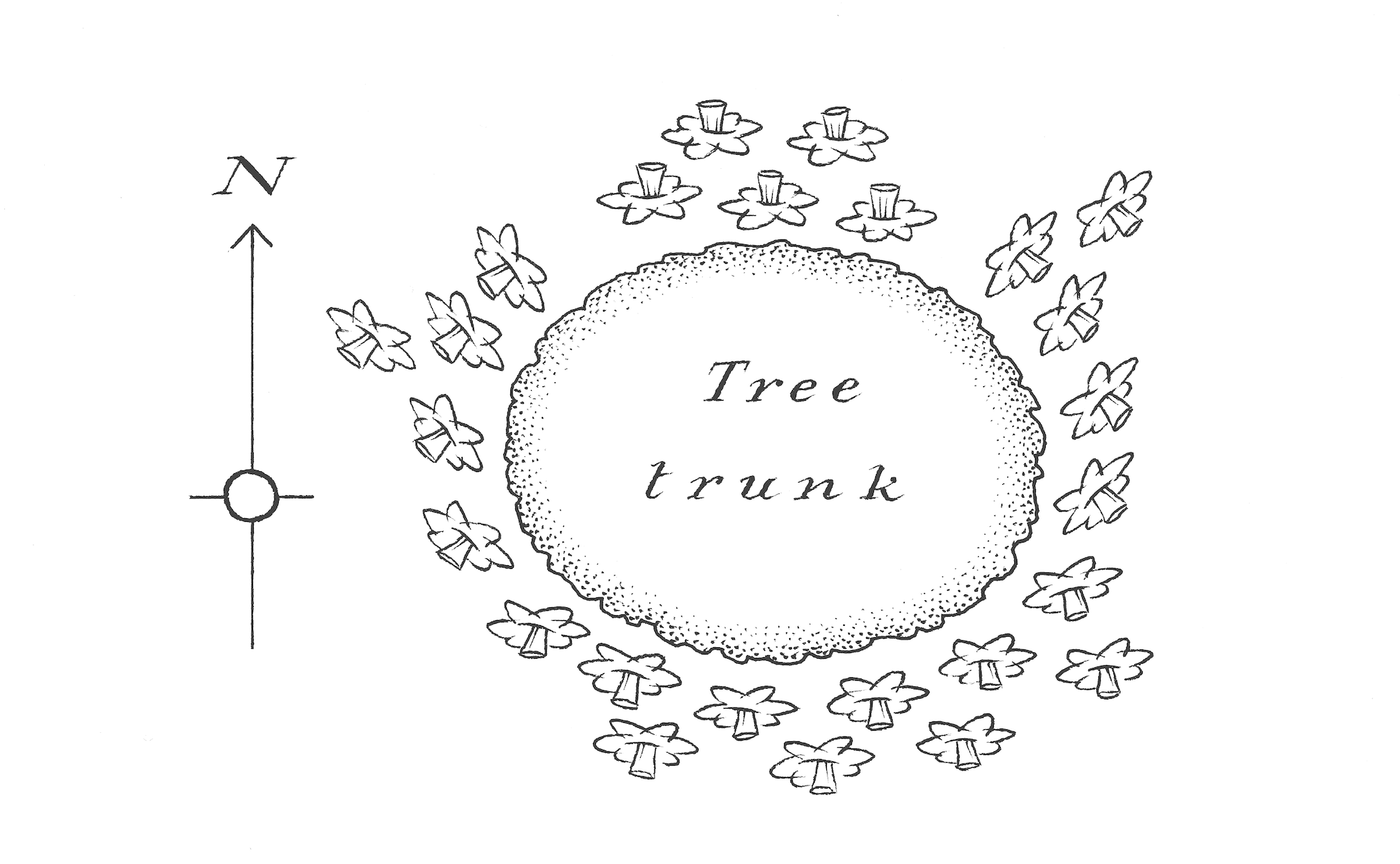
Illustration by Neil Gower
The second nuance to the flower compass is no less beautiful, but even subtler. The flowers and insects are in partnership and need to work together, which means being sensitive to their partner. In open ground the flowers are likely to face south, but if you see a slight consistent variation in a species, this is a clue to the flower knowing its partner insects’ habits well. All animals are habitual, and pollinators don’t spread their patrols evenly throughout the day. Some favour the morning and others start later. If a flower is trying to attract an insect that is busiest in the morning, which is very common, it will do better facing slightly closer to south-east than south, to catch the mid-morning light as the sun arcs from east to south.
April is a month of flowers, showers and fast-changing weather. This makes it the perfect month to look for how flowers herald weather changes. There are different examples to look for across the seasons, but get started early with the chickweeds that are open in fine weather, half closed in passing showers and fully closed as rain starts. Dandelions and daisies close at night or when rain is approaching. Red clover has leaves that respond to bad weather, rising and pointing upwards, revealing their pale undersides.
Small plants are at risk from grazing animals. Deer would make short work of the flowers if they hadn’t developed some resistance. Early spring flowers tend to be unpalatable to the grazing animals, or they would struggle against the ravenous appetites of mammals in spring. They use an array of tactics to put the animals off, including poisonous sap and hairy stems and leaves. If you are watching the same area carefully as spring progresses, you may spot this difference between early and later spring flowers: the first flowers show little damage from grazing, but the next wave suffers badly. It is sometimes possible to see this within the same family of flowers. Primroses and cowslips are members of the Primula genus that do well near me; the deer leave the early primroses but savage the later cowslips.
The Hidden Seasons: A Calendar of Nature’s Clues and Signs by Tristan Gooley (Hodder Press) is out now in hardback, eBook and audiobook. Tristan Gooley can be found on www.naturalnavigator.com and on his Instagram, @thenaturalnavigator