The holly and the ivy
Encounter’s founder, the nature writer Melissa Harrison, on why seasonal rituals are so important
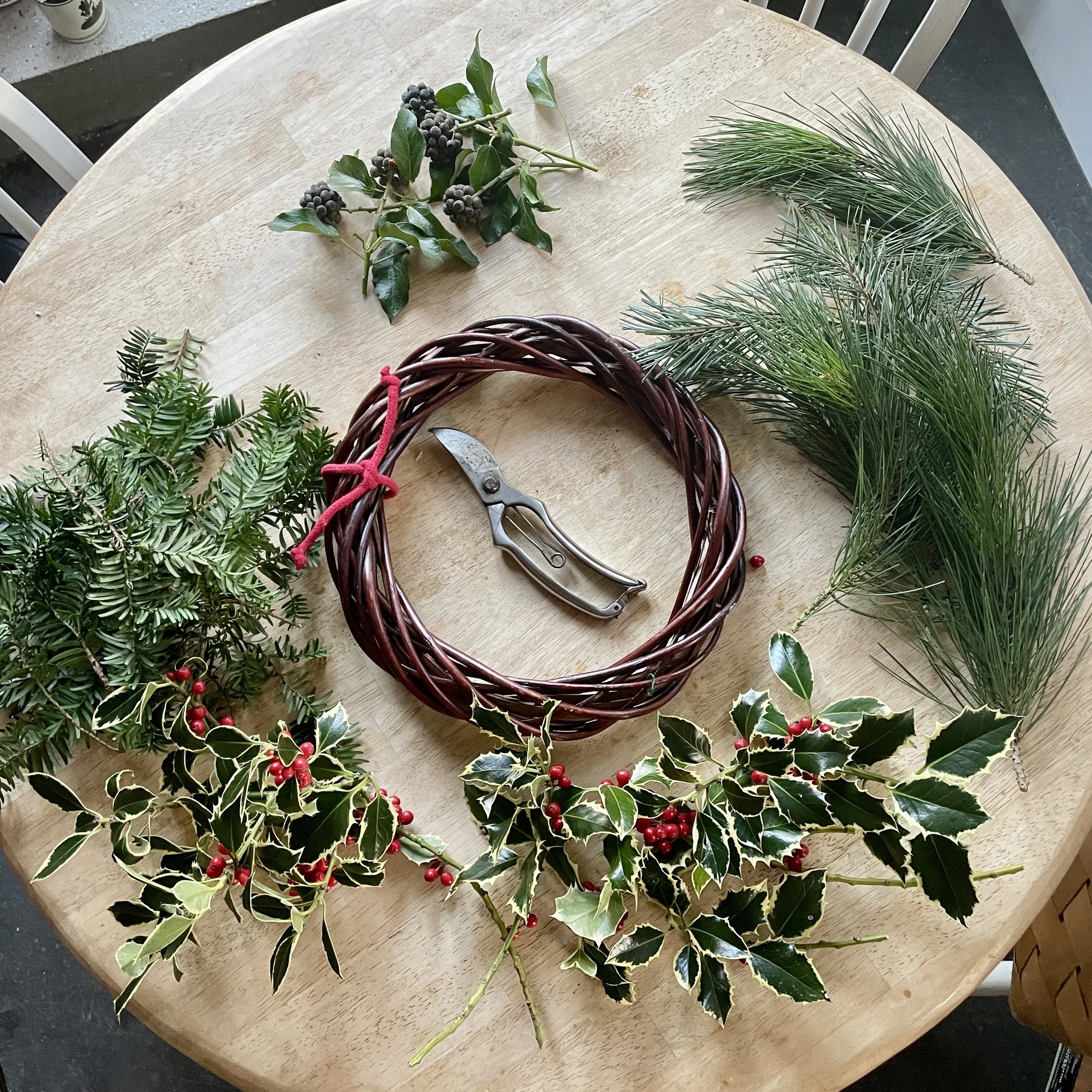
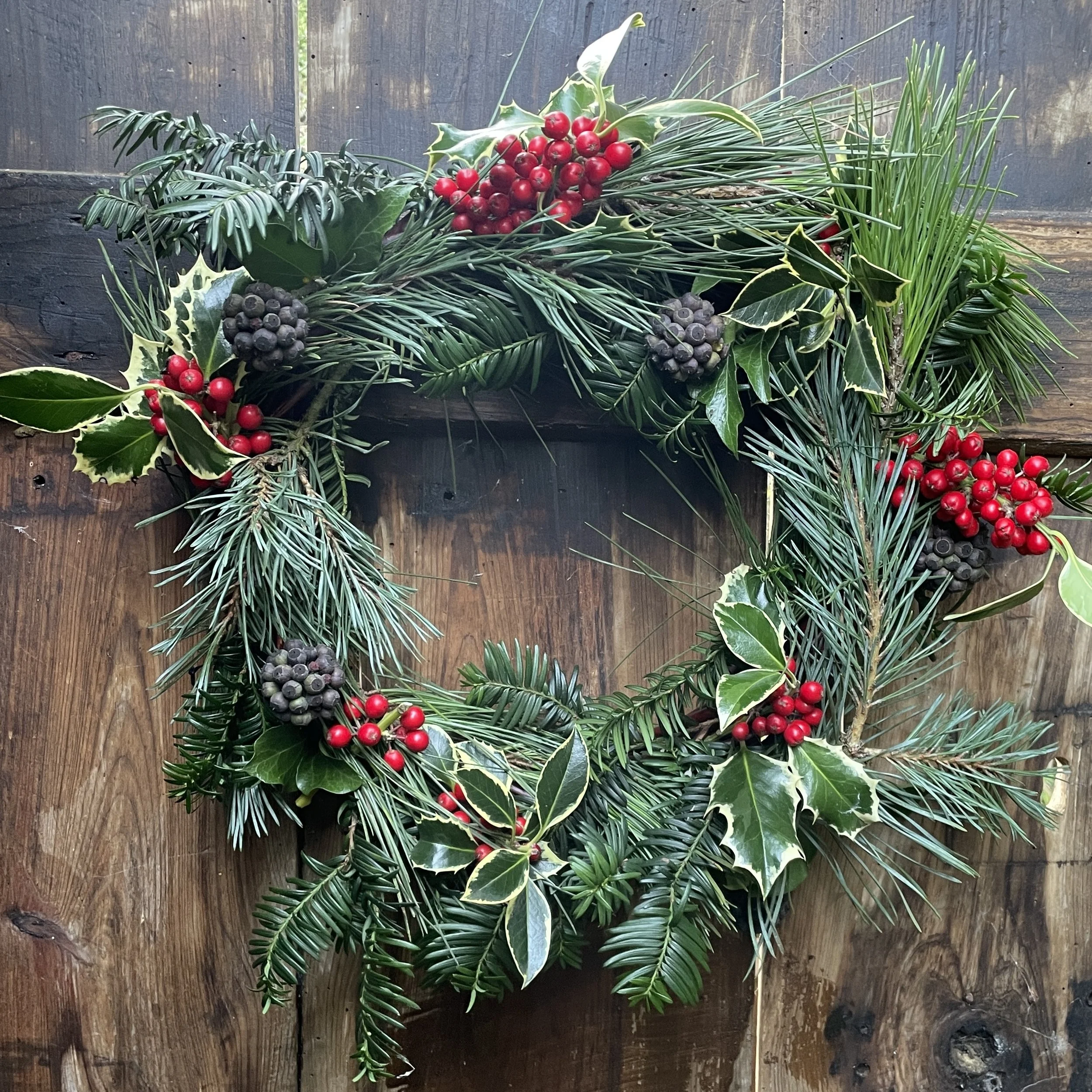
Every year, in the middle of December – usually on a weekend – I make a wreath of greenery for my door. I go out carrying a cotton tote and some secateurs, with my gardening gloves on, and snip holly, ivy and other evergreens from the local woods and verges, and sometimes I’ll collect cotoneaster berries, feathers, honesty pods, bracken or whatever else takes my fancy, too. I use the same woven base I bought online a decade ago, into which (while sipping a drink) I somewhat haphazardly stuff the stems of my chosen items, holding it all together with random bits of wire and thread. The berries go on last, so they’re visible; I might even string a length of battery-powered lights through it too. And then I hang it on my door until well after Christmas, renewing the berries if they drop off or are eaten by my garden birds.
It’s never symmetrical (or particularly chic) but it is honest and hand-made, and it won’t sit in landfill forever like some many artificial ones are destined to. And it reflects what can be found in a short radius around my cottage, which feels right. What’s more, the process of making it connects me not only to nature but to my forebears: bringing evergreens indoors at midwinter is an ancient tradition, probably pre-Christian. It’s a way of reminding ourselves that growth and life will return, even when everything is very dark and very still. After all, it’s only pretty recently that we’ve filled our parks, gardens and agricultural fields with non-native or selectively bred species that grow and bloom and remain green to fill up the colder and slower part of the year: for century after century – especially when winters were genuinely and reliably freezing and snowy – very little remained green and vibrant in the depths of winter except for holly, ivy and mistletoe.
I believe very strongly that seasonal rituals matter, whether it’s lighting a candle at the autumn equinox, jumping over a bonfire at midsummer, making a winter wreath or garland, or weaving a St Brigid’s Cross in early spring. You can make up your own, too, marking the things that matter to you as the year turns, as our ancestors did for time immemorial: you could mark the day the swifts return with a glass of champagne (or whatever takes your fancy), sleep out under the stars on the shortest night, collect a bowl of conkers every autumn or drive to a particular spot to watch the Geminid meteor shower each December. Whatever the seasonal moments are that speak to you, find a way to engage with them using your body and your senses, not just your mind.
And repeat the process yearly: that’s where the real magic comes in. A big part of what I’m trying to do with Encounter is to help people re-engage with the idea of the year as a repeating cycle, something that sounds too obvious to mention but which in fact I think we’re in danger of leaving behind. In our daily lives we have ‘conquered’ more and more of the natural world’s seasonal ‘inconveniences’, such as darkness, cold, heat and water scarcity, and in doing so we have become less and less embodied and more detached from the changing sensations of the year. It’s possible – especially in cities – to live a life almost completely detached from the seasons, one in which cyclical natural processes play almost no part at all. But doing that, though it may feel easy and frictionless, harms us in ways which are difficult to classify but which build up over time and make life less meaningful – and us less resilient, too.
But natural rituals aren’t just about reconnecting to nature and the seasons with our bodies and our senses. There’s something else I think they do, which is to mark the passage of our lives. Kids know this instinctively: do something twice and then it has to be done forever, and the same way each time – but as adults we let go of all that, willing to let our lives become featureless linear trudges towards a horizon we dare not look at. Yet it really doesn’t have to be that way.
Living within the cycle of the year is deeply comforting. It holds us within a time-structure we are built to understand, allowing us to compare one year to the next and get a sense of where we are on our life’s journey. It’s also incredibly forgiving: say your Christmas wreath was late, or wonky – so what? You’ll get another chance next year. Gardeners know this: every planting plan is a chance to erase last year’s mistakes and do better than before. And once upon a time everybody had that feeling, whether it centred around growing crops, harvesting and preserving food, animal husbandry, hiring fairs, country sports, the ecclesiastical calendar or a thousand other things. But there’s so little left when it comes to shared yearly markers now, and what there is has been relentlessly commercialised until it has very little to do with nature or the seasons, or spirituality, history or tradition, any more. And that has emptied the calendar of the things that once helped us understand time as well as the shape of our own lives, which are given meaning by it.
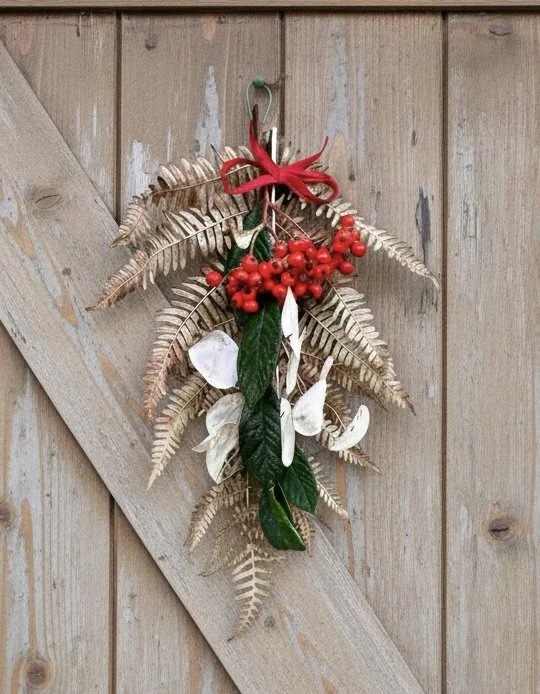
A smal garland, made one year when I didn’t have the wherewithal to make a wreath. Because it doesn’t have to be perfect.
Birthdays and New Year’s Eve are occasions when the year’s cycle can press close, and if you don’t have much of a relationship with the passage of time in the rest of your life, they can feel particularly acute. I’d like to advocate for a different way of living, one that doesn’t require vast changes to undertake but which can bring, I believe, huge benefits.
Use the Encounter app to notice more and more of the natural world around you, especially the way that it changes from day to day, week to week, year to year. Slowly you will become attuned to the way that things repeat, and you will welcome them, whether they return in the exactly same form as last year or in a slightly different guise. You’ll begin to get a sense for the natural variation of the seasons, as opposed to the way they are changing with the warming climate; and you’ll begin to understand yourself as an animal, too, naturally subject to the weather, to your local environment, even to the moon.
Most of all, develop your own ways of marking the points of the year that matter to you, using your perfectly evolved, animal body: touching, choosing, making, feeling, smelling, sensing. Seasonal rituals remind us that we are mortal animals, alive on a fiercely beautiful planet, and that, I think is a vastly underrated gift.